
From Assessment to Action: Beehive’s Product Features and Roadmap
If you’ve been following our journey, you know that our mission goes beyond simply providing data. We are building the operating system for enterprise climate risk management. Recently, we walked through a comprehensive update on where our platform is today, where we are heading in the next few months, and our broader vision for the future.
Whether you are a sustainability leader, a risk manager, or a finance executive, the goal is the same: to move from static reporting to dynamic, data-driven decision-making. Here is an overview of the latest features, our product roadmap, and how we are solving the most pressing challenges in the market.
Physical Risk: Precision, Transparency, and the "Audit Trail"
The traditional approach to physical risk assessment is often manual, opaque, and incredibly time-consuming. At Beehive, our approach is aligned with industry standard climate science, transparent, and repeatable.
Solving the Transparency Gap
Our customers need more than a score; they need defensibility. That is why we have doubled down on our Audit Trail features. When Beehive generates a risk score for your assets, whether it’s a data center in Virginia or a supplier in Southeast Asia, we don’t just give you a number. We provide the "why."
We are now leveraging embedded AI trained on our technical documentation to explain exactly how a score was calculated. If an auditor or an investor asks why a specific facility is flagged for flood risk, you have the scientific context, data sources, and methodology right at your fingertips. This transparency is critical for complying with regulations like CSRD, IFRS S2, and ASRS, where misleading disclosures can have serious legal consequences.
Custom Equations and Quantification
One of the biggest hurdles our clients face is translating climate risk into financial impact. Every business is unique - a tech company’s loss from a heatwave (spiking energy costs at a data center) looks very different from an agricultural firm’s loss (crop failure.)
We have introduced Custom Equations to solve this. You can now input custom equations based on variables you define, such as "cost per closure day" or "repair cost per asset". This allows you to tailor the financial quantification of risk to your reality, ensuring that the data speaks the language of your CFO and your board.
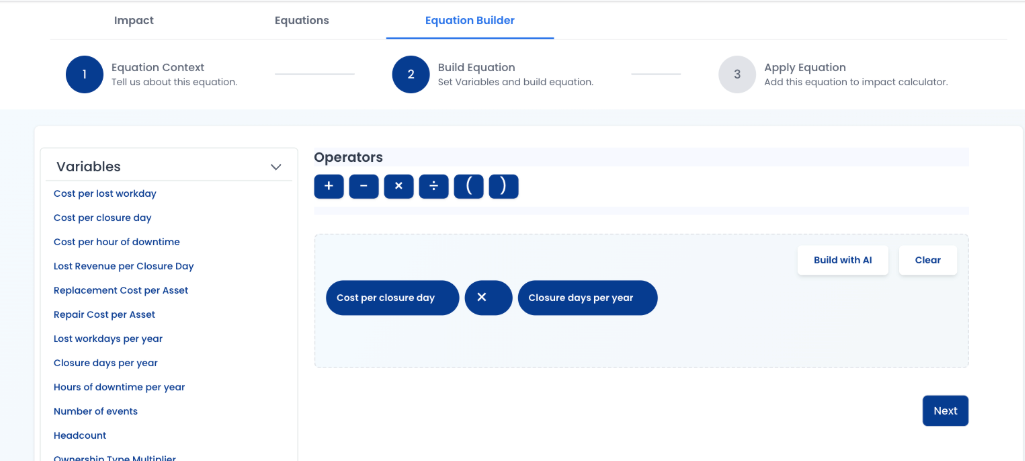
Figure: Beehive’s custom “Equation Builder”, allowing organizations to maintain agency over how their financial risk is quantified
Portfolio "Snapshots"
A major pain point we have recently solved is historical data integrity. As your business changes (i.e., offices open, employees move, suppliers switch) your risk profile changes. Our portfolio snapshots feature allows you to freeze your asset portfolio in time, and start with a fresh version. This enables you to maintain a pristine audit trail. If an auditor in 2026 asks about your 2024 disclosure, you can pull up the exact version of your company and the associated risks from that period, rather than running a retroactive analysis on your current assets.
Transition Risk: The AI Consultant
Transition risk analysis has historically been the domain of expensive, months-long consulting engagements. Our goal is to replicate that quality of insight in minutes, not months.
Automated Benchmarking and Analysis
Our platform acts as an intelligent analyst. It ingests your 10Ks, ESG reports, and public data, as well as those of your peers, to identify material risks and opportunities. It then identifies applicable risks and opportunities for your organization for your review.
We have refined our Benchmarking capabilities to allow you to see exactly what your competitors are disclosing. If a peer identifies "shift in consumer preferences" as a risk, Beehive flags this for you and cites the specific page in their report. This gives you the confidence to accept or reject risks based on industry standards.
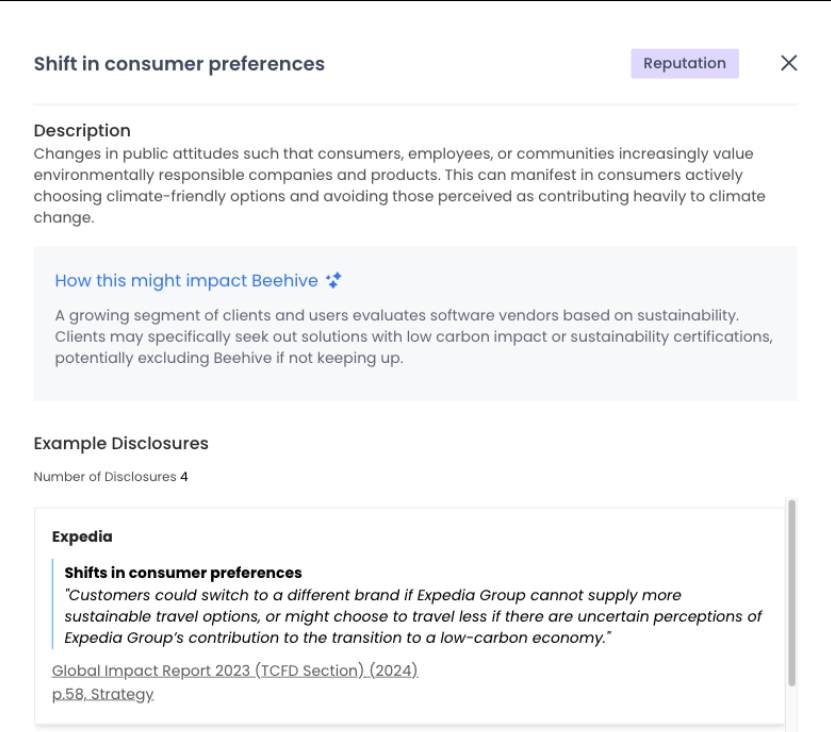
Figure: Beehive’s AI automatically identifies risks and opportunities and shows how peers are reporting on similar risk and opportunities in their publicly available disclosures.
NGFS Scenarios
We have recently integrated NGFS (Network for Greening the Financial System) scenarios. This will allow you to model transition risks, such as carbon pricing or regulatory shifts, across different global policy futures. You will be able to toggle between different scenarios (e.g., “Net Zero 2050”) to see how your financial exposure changes, fulfilling complex IFRS requirements with ease. Completing a scenario analysis, which is required by most regulations, could normally cost upwards of $50,000 and take two months with consulting engagements; however, this process is done in minutes with Beehive.
Risk Planning and Management
Perhaps the most exciting development at Beehive is our shift from risk assessment to risk planning. It is not enough to know that a hurricane might happen. You need to know which assets could be impacted by what type of disaster in what month, so that you can prepare.
The "So What?" Factor
We are rolling out a Risk Planning Module designed to help you answer immediate operational questions. Instead of looking 30 years out, this module allows you to look at the upcoming quarter (e.g., April through June) and ask:
· Which disasters are seasonally probable in my operating regions?
· Which specific assets (offices, critical suppliers) are in the line of fire?
· What is the potential financial impact if a specific event, like a Category 4 hurricane, occurs?
This moves climate data out of the annual sustainability report and into the quarterly business review.
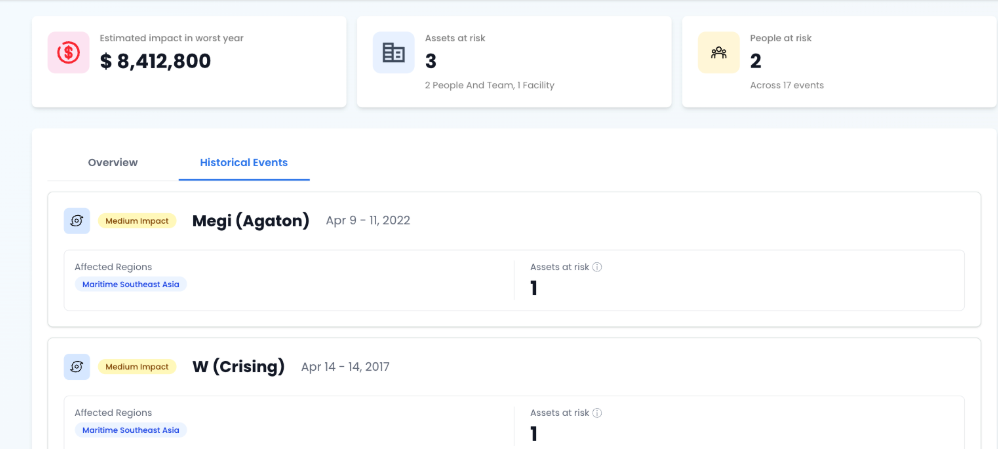
Figure: Overview of Beehive’s “Risk Planning” feature, allowing users to see the historical events that would have impacted their assets if occurring this year
Operationalizing the Response
Our long-term vision for risk management is tactical. We are building toward a future where Beehive doesn't just warn you of a risk but guides your response.
Imagine a system that alerts you to a developing weather event, identifies the 300 employees and six facilities in its path, and immediately pulls up your business continuity plan. We envision a platform that helps you execute evacuation protocols, communicate with affected stakeholders, and manage the crisis in real-time. That is true resilience.
Reporting: From Documents to Decisions
Finally, we are revolutionizing how you communicate this data. Currently, our AI helps draft comprehensive TCFD and IFRS-aligned narratives with version control, streamlining the collaboration between legal, finance, and sustainability teams.
Visualizing the Data
However, we know that executives don't always want to read a 50-page document. Our vision includes integrating advanced generative AI to instantly create presentation-ready slide decks. You will be able to export your risk assessment directly into a visual format that highlights key financial exposures, heatmaps, and strategic recommendations to be ready for the boardroom with the click of a button.
At Beehive, we are committed to helping you navigate the complex landscape of climate risk with speed, accuracy, and auditability. We are moving beyond compliance to help you build a truly resilient enterprise.
For more information on the current state of our product, see our recent webinar with our CEO, Adriel Lubarsky: